Getting there
How to get to Gravensteen
Train, tram, bike or on foot: how to reach Gravensteen in the car-free centre of Ghent, and where the boat trips fit in beside the castle walls.
Book the boat trip ↗Quick answer
Gravensteen stands in the middle of Ghent, so the simplest route is a train to Gent-Sint-Pieters, then a tram into the historic centre and a short walk. The centre is largely car-free, so a car does not help. Cyclists are well provided for, and the boat trips on the canals pass the walls from the water.
Where the castle stands
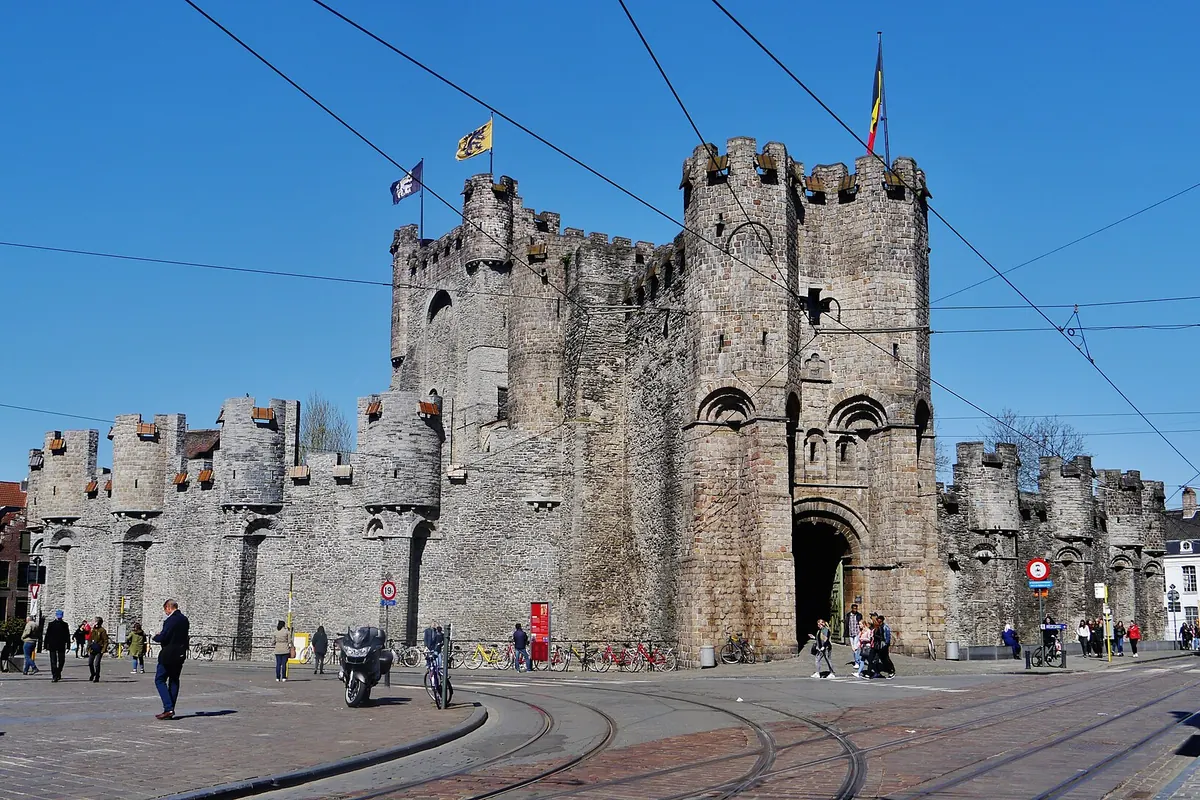
Gravensteen is a moated castle in the middle of Ghent, in East Flanders. Its old outer yard is now the Sint-Veerleplein, the square in front of the gatehouse. The castle's own history page calls that yard the outer bailey. It also stands where the Lieve canal begins: Dutch Wikipedia says the canal was dug from 1251, starting at the Gravensteen and running to the Zwin near Damme. Water is part of the approach, then, whether you arrive on foot, by tram or on a boat. Wikipedia lists the castle among the highlights of a medieval core that is largely car-free.
Your options at a glance
Most visitors use one of four routes. Choose by where you are staying and how much walking you want. None of them needs a car, because the centre is built around trams, bikes and feet. If you are unsure, the train and tram combination is the easiest to plan, the bike is the most local, and the boat is the only way to see the castle from the water.
- Train to Gent-Sint-Pieters, then tram
- Tram or bus from elsewhere in the city
- Bike, using the city's cycle paths
- Boat trip along the old port quays
By train to Gent-Sint-Pieters
Wikipedia describes Gent-Sint-Pieters as the international station, with connections to Bruges, Brussels, Antwerp, Kortrijk, other Belgian towns and Lille, plus a direct connection to Brussels Airport. Gent-Dampoort is the other intercity station. Neither station is at the castle, so you finish the trip on a tram, a bike or on foot. From Sint-Pieters you can change to a tram, and the same route works for a day trip from Brussels, Bruges or Antwerp, since all three have direct connections. Pick your return train before you set out, so the last hour of the day is not a scramble.
By tram into the centre
Trams run from Sint-Pieters station to Korenmarkt, in the city centre, a short walk from the castle. Because the network has been reorganised in recent years, check a current network map for the line that stops at the castle today rather than relying on an older source. Allow for a walk at the end either way: the final stretch to the gatehouse is on foot across the square. Wear shoes that suit paving and the castle's stone stairs, if you plan to go in.
On foot through the old centre
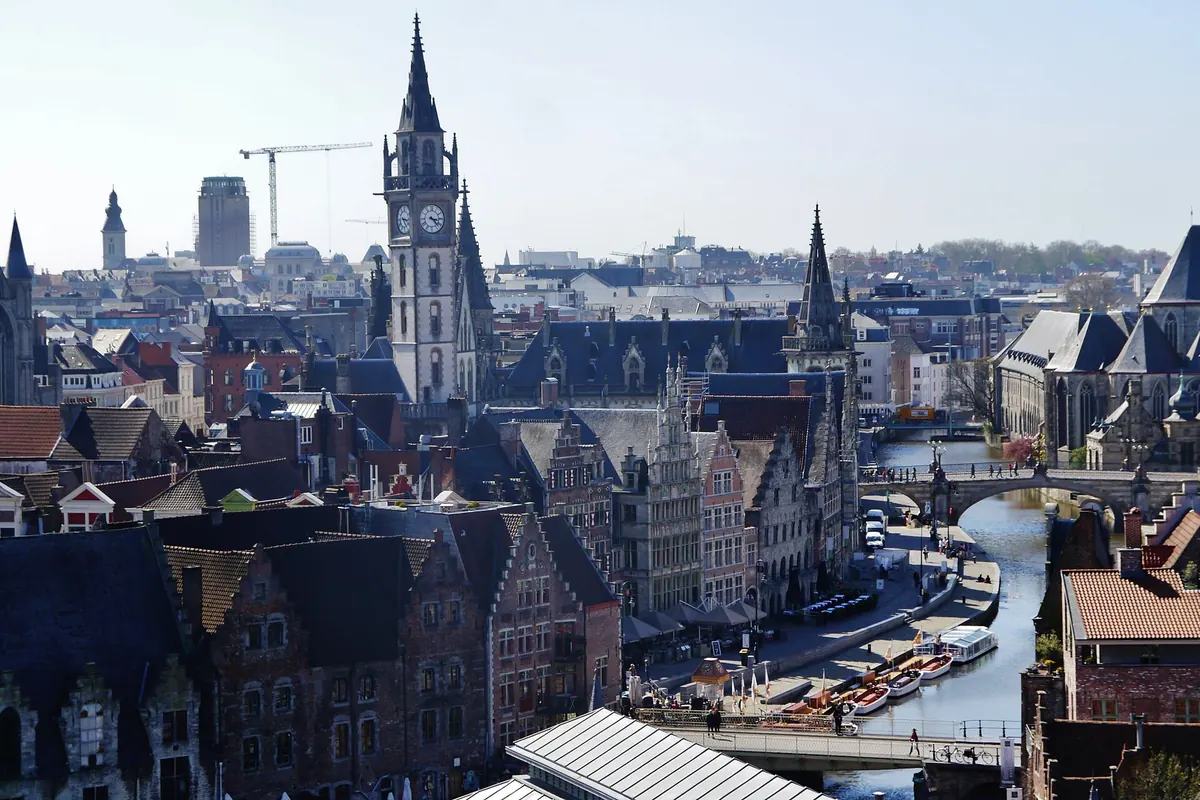
Ghent's historic core is compact, and Wikipedia names the Gravensteen, St Bavo's Cathedral with the Ghent Altarpiece, the belfry and the old Graslei harbour as its highlights. Graslei and Korenlei, the two facing quays on the Leie, were part of the medieval port and are now lined with café terraces. A walk between them and the castle is a walk through old Ghent, past guild houses, churches and canal bridges. You can steer by the three medieval towers that overlook the centre: the belfry, St Bavo's Cathedral and St Nicholas' Church. The belfry rises about 91 metres, so it is the easiest of the three to find above the rooftops.
By bike
Ghent suits cyclists, with a long network of cycle paths and a largely car-free centre. If you are staying outside the centre, a bike is often the quickest way to reach the castle square. Lock the bike at a stand near the square rather than against the castle wall, and use a bike rather than a car for the last stretch whenever you can.
By car
Wikipedia describes the city centre as a car-free area, so driving to the castle gate is not an option. If you arrive by car, leave it outside the centre and continue by tram, bike or on foot. Use the city's own parking information to choose where to leave it, because car parks and their rules change and no source on this page can give you a current answer. The train is usually the simpler way to reach Ghent if you are coming from Brussels, Bruges or Antwerp.
From the water
Both boat trips on this page pass Gravensteen from the water. The 40-minute trip starts on the Korenlei quay, and the 50-minute trip has two starting points to choose from, so check which one your booking uses before you set out. A boat trip is not a way to the castle door: it passes the walls and the other waterside landmarks while a guide talks. Entry to the castle is a separate matter, covered in the next section. Both trips give live commentary from a guide in Dutch, English and French, which is useful context before you walk up to the gatehouse and decide whether to go in.
From Brussels or Bruges
Gent-Sint-Pieters has direct rail connections to Bruges and Brussels, so you can reach Ghent without joining a tour. If you would rather not plan the day yourself, a guided day tour from Brussels combines Ghent and Bruges in about ten and a half hours, with a guided walk in Ghent that takes in the Castle of the Counts. It is a coach tour with a guide, not a castle visit. The Ghent part of the day is a walk past the castle, and you decide whether to add a ticket to go inside.
Getting in once you are there
The castle sells its own entry. Its website, run by Historische Huizen Gent, says the castle is open every day and advises booking online in advance. None of the tours on this page includes castle entry. Buy it from the castle's own website or at the gate. An audio guide comes with castle entry, so you do not need to arrange one separately.
Who these routes aren't for
The castle's own site describes narrow tower stairs, high rooms and real battlements. That suits most visitors, but not everyone. If stairs are a problem, read the castle's accessibility information before you go, and remember that you can see the walls without a ticket: from Sint-Veerleplein, from the canal bank or from a boat on the water. A boat trip is also a sensible choice if you want the castle in your day without climbing it.
Frequently asked questions
What is the nearest train station to Gravensteen?
Neither of Ghent's two main stations is at the castle. Gent-Sint-Pieters is the international station, and Wikipedia lists tram lines from there to Korenmarkt in the centre. Finish the trip on a tram, a bike or on foot.
Can I take a tram to the castle?
Yes, trams run to Korenmarkt in the city centre, a short walk from the castle. The network has changed in recent years, so check a current map for your line.
Can I drive to Gravensteen?
Not to the door. Wikipedia describes Ghent's centre as a car-free area. Leave the car outside the centre and continue by tram, bike or on foot.
Is it a long walk from the Graslei quay?
The old centre is compact, and the Graslei, the belfry and the castle are all part of the same historic core. Plan a relaxed walk through the old streets rather than a long trek.
Is it better to take a tram or walk?
It depends where you start. From Sint-Pieters station a tram saves the first stretch, and the old centre is compact enough to enjoy on foot once you are in it. Finish the last stretch across the square on foot either way.
Can I get to Gravensteen on a day trip from Brussels?
Yes. Trains link Brussels and Ghent, and a guided day tour covers Ghent and Bruges in one day. Neither includes castle entry, which you buy from the castle itself, either online or at the gate.
Sources